
If you mail once, you can't see which list, message, or month worked.
Flooring play · Direct mail marketing
Flooring direct mail marketing that runs every month, not once a year.
One-off mailings feel like gambling. Spur sets up four standing lists, writes each message, mails on a schedule, and shows your cost per measure so you know which list earns its postage.
Free forever plan · No card · 20 property searches a month
USPSFirst-Class
Karen Doyle58 Foxglove TrlNashua, NH 03062Scan to claim a measure slot
Karen D. scanned wave 2 and asked for samples · 6 min ago
AI-written for this owner · Mailed in 2 days
4 listscarpet age, hardwood, new buyers, past customers
Monthlyone wave scheduled, then repeated
$/measurecost per booked measure by list
The problem
A single mailing can't tell you whether direct mail works.
Quiet weeks between drops mean an uneven calendar and idle crews.
Without scans and bookings tied to a list, spend is a guess.
How it works
From list to mailbox in one workflow.
Five steps from scattered mailings to a program you can measure.
app.usespur.com
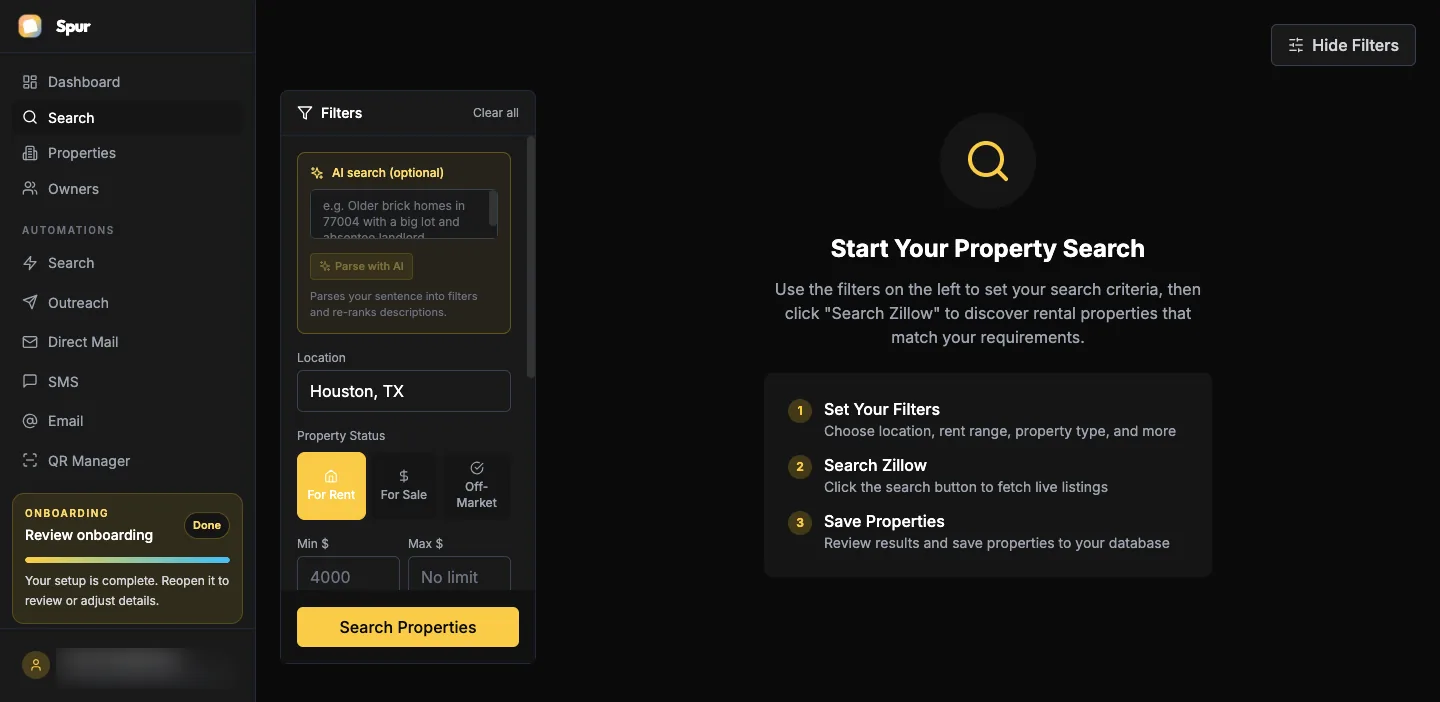
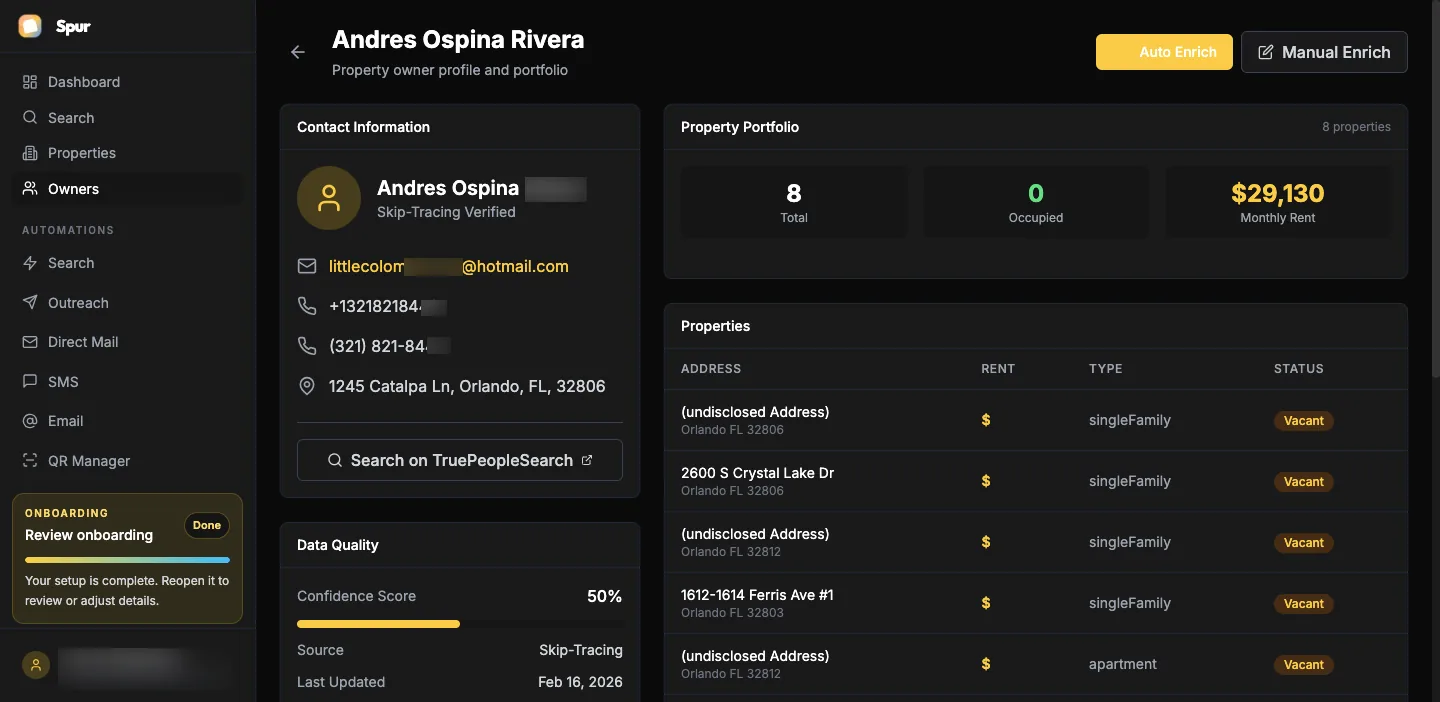
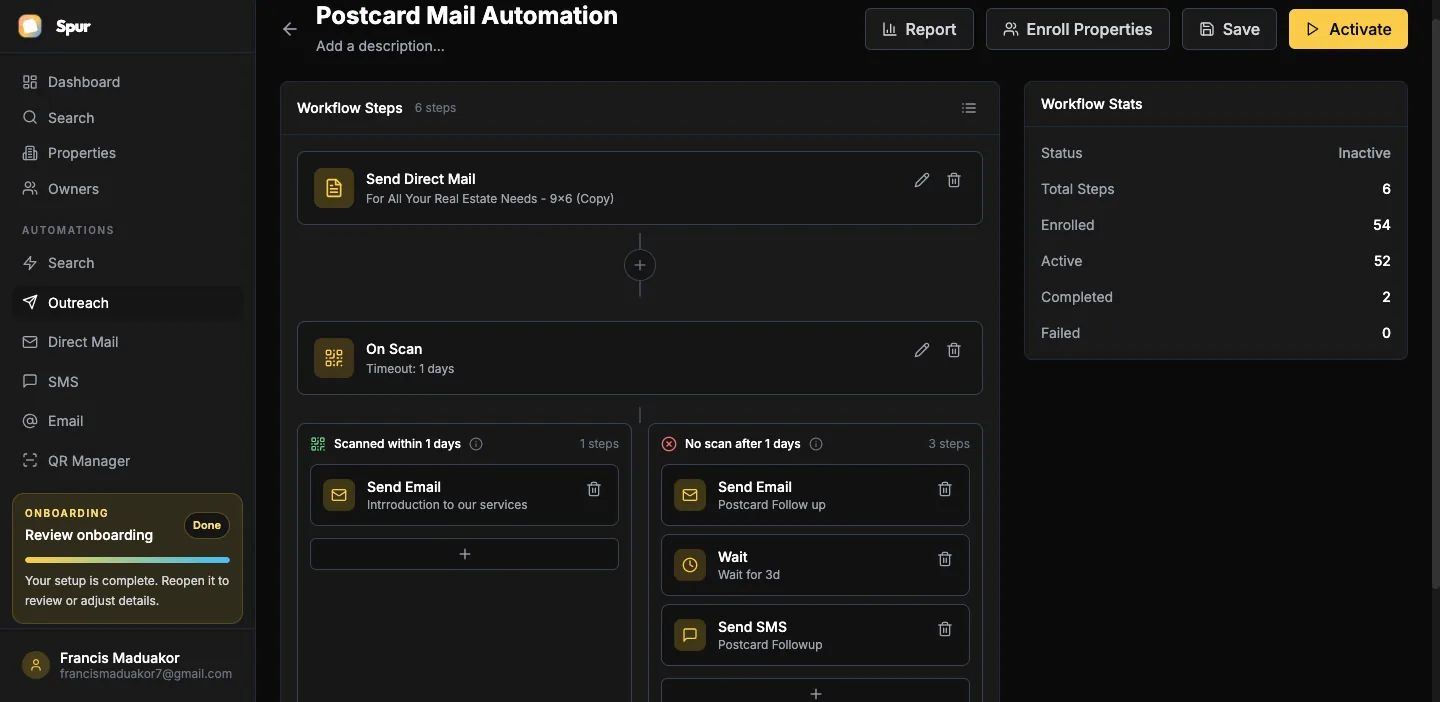
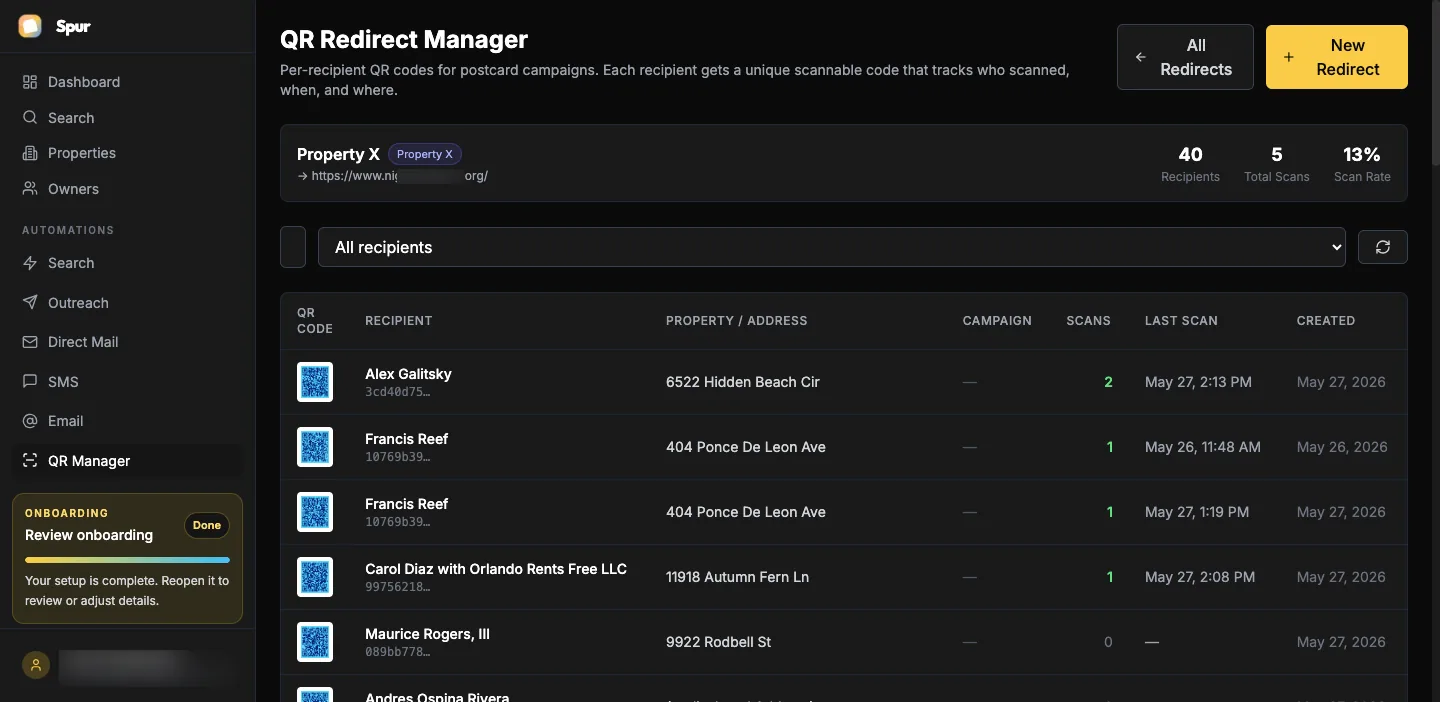
See it in Spur
A monthly flooring mail program
Sample Nashua, NH program across four lists. Counts are illustrative.
4 standing listsOwner-occupiedBuilt 1995–2010 or pre-1960Radius 15 miPlus past customers
- Carpet-age homes420 homesMail first weekBuilt 1998–2008
- Older hardwood homes260 homesMail second weekBuilt pre-1960
- Recent buyers140 homesMail within 45 days of saleSold last 90 days
- Past customers180 homesMail at 12 monthsYour list
- Pre-sale owners95 homesMail third weekOwned 15+ yrs
AI draft for Karen D. · 58 Foxglove Trl
Hi Karen,
Our crews are measuring in your neighborhood this month. Many homes on Foxglove Trail were built in the early 2000s and still have their original carpet.
We bring samples of luxury vinyl plank, engineered hardwood, and carpet to your door, measure free, and send a written quote. Installs are booking three weeks out.
Scan the code to claim a measure slot.
Sean Pelletier · Granite State Floors · (603) 555-0127
Sample data for illustration. Your results depend on your market and filters.
Playbook
How a flooring direct mail program is built
Direct mail works for flooring when it is treated as a program, not a promotion. A homeowner who isn't ready this month may be ready in six. A steady cadence keeps your name in the mailbox so that when the carpet finally gives out, you are the installer they already know.
Start with four lists, because they behave differently. Carpet-age homes, built roughly 1995 to 2010 with owners of 10 years or more, are the volume engine. Older homes built before 1960 are the refinishing list, where original hardwood may be restorable. Recent buyers replace floors around the move, often before they unpack. Your past customers buy again when a second floor or a house sale comes up.
Give each list its own message. Carpet-age owners respond to the age of the home. Hardwood owners respond to character and restoration. Recent buyers respond to a move-in timeline and an empty-room discount. Past customers respond to a thank-you and a referral thank-you offer. One generic message across all four wastes the targeting.
Set a cadence you can keep. One wave a month, rotating which list leads, is easier to sustain than a quarterly blast. Mail each household no more than every six to eight weeks so the card feels helpful rather than repetitive, and suppress anyone who has already booked.
Measure cost per measure, not response rate. A list that scans often but never books a measure is a curiosity. A smaller list that books measures is the one to grow. Spur shows scans and bookings by list so you can shift postage to the winner within one or two cycles.
Plan capacity. A good wave can book more measures than your estimator can run in a week. Cap the offer by slot, tell owners that installs are booking three weeks out, and use the QR page to show open times. That keeps the experience honest and protects your reviews.
Layer direct mail with the rest of your marketing. The QR page can point to a project gallery and your Google reviews, so a homeowner who scans can see proof before booking. Over a year, the program compounds: each wave warms the list the next one reaches.
10×+return on a year of Spur Team from a steady mail program
A program that books four jobs a quarter pays for itself fast.
- Spur Team: $49/mo billed annually = $588/yr
- 12 waves of 250 cards at $0.94 each = $2,820
- 10 installs a year (~$5,500 each) ≈ $55,000
Example math. Booking rates and job size vary by market. Run your own numbers →
One tool, not four
Spur vs. one-off flooring mailings
What you needThe usual waySpur
Four standing listsA single blanket mailing✓ Built in
Monthly waves scheduled onceRemade when someone remembers✓ Built in
Cost per measure by listTotal spend only✓ Built in
Suppresses booked householdsMails everyone again✓ Built in
Printed and mailed for youDesign, proof, print, drop✓ Built in
Direct Mail Marketing by the numbers
Why a steady cadence beats one big drop
Repeat
contact is the main lever for a considered purchase with a long decision window
10–15 yrs
typical service life of residential carpet
10×+
return on a year of Spur Team from a steady mail program
FAQ
Flooring direct mail questions
How often should a flooring company mail?
One wave a month works well for most shops, rotating the lead list. Mail any single household no more than every six to eight weeks.
How much should I budget for flooring direct mail?
A common starting point is 250 cards a month. Review cost per measure after three waves and scale the lists that book.
Which list should I start with?
Start with owner-occupied homes built 1998 to 2008 with owners of 10 years or more. They are the largest group likely to have original carpet.
Can I mail my past customers?
Yes. Upload a CSV from your invoicing system, or mail the neighbors of your recent installs.
What does Spur cost for a flooring mail program?
Solo is free forever. You pay per postcard when you mail. Team is $49/mo billed annually with more searches, automations, QR codes, and lower postcard pricing.
Keep exploring
Related plays and guides
Start in minutes. No card required.
Make direct mail a calendar, not a gamble.
Set up four lists and a monthly wave once, then read the cost per measure. Free to start.
Start my flooring mail program — freeFree forever plan · No card · 20 property searches a month
Prefer a walkthrough? Book a demo